
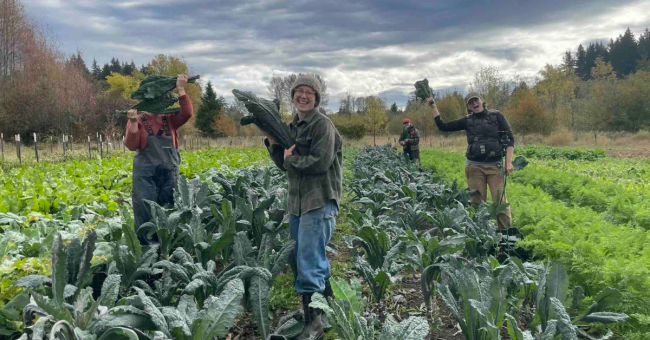
Full Cellar Farm has a powerful and straightforward mission: To grow food for as many people in the community as possible.
 Located in unincorporated Multnomah County, OR, the farm operates on a model known as Community Supported Agriculture (CSA). Customers buy “shares” in the farm, helping to stabilize cash flow, and they receive ten months of ultra-fresh vegetable bundles in return.
Other sales channels include selling to schools and through an online marketplace called the East County Food Hub.
To manage these projects, owner Emily Cooper has been seeking out further guidance on planning and business practices. This led her to Business Impact NW’s “Root to Rise” Farm Business Accelerator, which connects farming professionals with mentorship, training, and bookkeeping support.
A life dedicated to farming and nonstop learning
Emily has been farming for nearly two decades, starting in 2008 as an apprentice at Backyard Gardens in Joseph, OR. In 2014, she started Full Cellar Farm through a farm business incubator. The original CSA concept focused on growing bulk crops for people who were interested in canning and preservation.
 The following year, Emily transitioned to a more traditional CSA, and this was the only thing Full Cellar Farm offered for several years. She’s added some other marketing channels recently, but the CSA still makes up a solid 75% of the farm’s sales.
A love of learning is what fuels Emily’s love for farming. From ensuring that Full Cellar Farm’s cultivation methods are safe for Oregon’s salmon-containing watersheds to empowering her employees through a holacratic organizational structure, Emily leads with deep insight and a reverence for what farming can do for a community.
A ton of growing in 2024-2025
Full Cellar Farm planted a LOT of seeds over the last two years—both literally and figuratively (but most importantly figuratively). These included starting the Food Hub, building a new website, and increasing their wholesale sales to local schools. In Emily’s words:
“Our mission has always been to grow food for as many people in the community as possible.”
The farm also redid their entire CSA calendar to sell harvest shares from September through June and take time off to plant winter vegetables during July and  August. This season differs from what most farms do, so it requires more intensive marketing.
Connecting with other farmers through Root to Rise
With so many irons in the fire, and particularly with the relatively new Food Hub, Emily turned to Business Impact NW’s Root to Rise program for mentoring and networking opportunities. As part of the program, she received one-on-one consulting from Chandler Briggs at Hayshaker Farm in Walla Walla, WA.
Chandler had started a food hub in 2020, and Emily “figured he’d be a great resource for more specific startup questions, like what kind of business entity we should make our food hub and how much work we should anticipate when we first start it.”
Root to Rise is a three-month program that happens annually in the winter, when farmers can really focus on business development. It’s free, but spaces are limited, so people have to apply. Ideal participants are farmers who have been in operation for two or more years and have specific goals and priorities but need help with strategy and/or resources.
 Resources fall into three main buckets:
- Business Impact NW’s in-house business coaching on cash flow projections, loan readiness, and other needs;
- Presentations and peer-to-peer mentorship from three small- to mid-scale farmers who are running successful operations; and
- Professional bookkeeping support at no cost to the participant.
Emily went to all of the presentations.
“The quality of presentations from all three farmers was amazing,” she says. “They all gave me good information to think about. There was the food hub stuff from Chandler, and Lili Tova (Flying Coyote Farm) had great things to share about hiring and employee management. They obviously put a lot of time and thought into it.”
Making the most of the free bookkeeping support
Cleaning up the books is a crucial step for successfully applying for loans, since it allows farmers to run more accurate reports. Emily was eager to learn how to better use QuickBooks to inform her business decisions.
 She worked with Maya Rose, Senior Managing Business Advisor, and was able to completely revamp her books.
“Getting the bookkeeping help was SO valuable,” Emily says. “It’s so much easier now to see how our sales break down into the different marketing channels, and it’s much more organized.”
Maya enjoyed her time working with Emily. “She’s pretty awesome and a very good example of someone who knew what they were needing and really utilized the resources in the program well. It just goes to show that if you’re present and you’re participating, you can get a lot out of the program.”
Emily agrees. “I was super grateful for the free program, and I’m really glad I did it!”
With the mentorship under her belt and a lot of seeds planted, she’s enjoying the process of tending to Full Cellar Farm’s many projects, watching them flourish like the nutritious crops out in the fields.
Root to Rise will open applications for its next cohort this fall. In the meantime, farm and food businesses can connect with Business Impact NW for free business coaching, trainings, and financing support.
About the author

Robin Kallsen
Robin Kallsen is a Seattle-based freelance copywriter who crafts detailed, fun-to-read articles on market research, cybersecurity, and other topics. She’s also a musician who busks at Pike Place Market during the tourist season, playing bass while singing vintage jazz, blues, and French songs.