
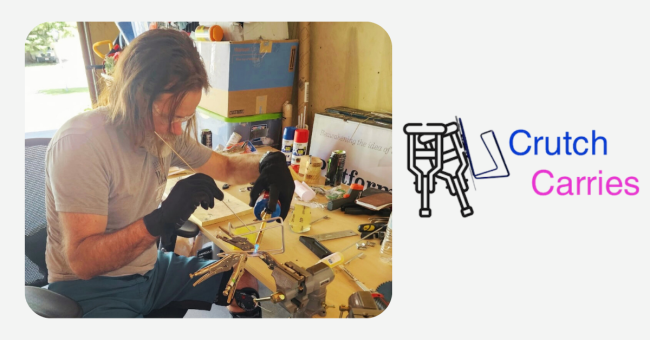
Joshua Yocum, a U.S. Marine Corps veteran and licensed physical therapist in Idaho, spent five months—nearly half a year—on crutches while recovering from surgery for a bone tumor. He felt the loss of independence deeply.
He needed help with the smallest of things, like carrying cups across the room. Hydration is key to recovery, but he could only drink while standing at the sink.
 Why wasn’t there a better way to help people with mobility devices carry cups and water bottles? Joshua had an idea, and it would soon lead him to file a patent, start a business, and connect with Business Impact NW.
From bicycles to mobility devices
Joshua is a triathlete, and he’s familiar with the water bottle cages used on bicycles. He took one off his bike and put it on his crutches. It sort of worked, but it was too small and the bolts didn’t line up.
Realizing he could do better, Joshua DIY’d a bigger version with properly spaced bolts. Then he tackled the real engineering challenge: making the design both durable and useful.
First, he tried aluminum on aluminum backing, but it wasn’t strong enough. An engineer friend made a key suggestion: Try 3D-printing a plastic piece to hold the aluminum cage and the bolt-on part together.
It worked like a charm! Even better, Joshua could emblazon the plastic with his new business name: Crutch Carries.
Real-time feedback from patients
 As a Physical Therapist, Joshua had access to a group of people experiencing mobility issues and possibly using a mobility device (as do around 25% of people aged 65 and up). His patients gladly gave the cup holder a try.
The safety implications were clear from the get-go.
“With walkers and crutches, the weight goes through your hands to support your body,” Joshua explains. “If you’re trying to carry another item, you no longer have control of your walker or crutches. And if you spill a drink, now the floor’s wet. That’s even more hazardous.”
Right up there with safety is quality of life. With the cup holder, Joshua’s patients gained independence.
While validating the product idea, Joshua tested prototypes. This is how, for instance, he determined that the metal-on-metal version lacked stability. He also learned that the paint would scratch if it wasn’t powder-coated.
Soon, the design was ready for prime time.
From patents to pitch competitions
“You need to make sure you protect your IP,” says Joshua, “because this is the foundation of what you do.” He filed a provisional patent in July 2024. “I didn’t want anybody to steal my idea.”
Joshua set out to get funding and exposure, connecting with business coach Paige Wiscombe through the Boise Trail Head Mentor Site. Paige told him about Business Impact NW’s IMPACT Pitch competition and a pitch competition run by the Idaho Veterans Chamber of Commerce for veterans and spouses. Joshua entered both.
Paige and Joshua worked together for many hours refining his pitch deck, vetting marketing plans, writing a business plan, and making financial projections. “It’s a growth process,” Joshua emphasizes. “You have to dive in and really get to know your business. It’s not easy!”
The hard work paid off. Joshua took second at the Idaho Veterans event, and he won a community impact award and made it to the finals with IMPACT Pitch. More importantly, he was raising awareness about Crutch Carries—every step of the way.
He found Paige’s mentorship invaluable. “She’s a great coach! She’s part of why I was able to make it as far as I did. She doesn’t tell you what to do—she guides you to figure it out on your own.”
Paige also enjoyed working with Joshua.
“He wasn’t afraid to jump in, ask questions, and really do the work,” she says. “What impressed me most was his decision to go all-in and make Crutch Carries his full-time thing. That takes serious guts—the kind of courage that probably comes from his background as a Marine. Watching him take an idea from lived experience and turn it into something that’s helping others has been incredible.”
Real impact for people facing mobility challenges
 Joshua’s driving force is deeper than simply owning a business and making money. “As an entrepreneur, you have to know why you’re doing what you’re doing, and money can’t be the why. I’m doing this to improve the quality of life for people on mobility devices. This is right in my mission statement. Every time I sell a drink carrier to somebody, I’m improving their life.”
Crutch Carries’ patent-pending design is already helping people with crutches and walkers enjoy greater levels of safety, hydration, and independence. In the near future, Joshua is looking to tailor premium products to wheelchairs and knee scooters.
He’s grateful for the help Business Impact NW has provided. “I have the tools and resources to be more successful because of Business Impact!”
Looking for the tools or funding to fuel your own idea? Check out Business Impact NW's free business coaching for help.
About the author

Robin Kallsen
Robin Kallsen is a Seattle-based freelance copywriter who crafts detailed, fun-to-read articles on market research, cybersecurity, and other topics. She’s also a musician who busks at Pike Place Market during the tourist season, playing bass while singing vintage jazz, blues, and French songs.